AI (Artificial Intelligence) has become THE business and IT buzzword for this decade. The hyper-focus on the technology comes from the promise of increased efficiency and higher returns for less capital outlay. Established organizations believe that they can save on their personnel budget, while start-ups see AI as an opportunity to scale in a way that allows them to better compete with established competitors.
However, these benefits can only be reaped by those who are strategic in their AI implementation decisions. Companies are finding that it is not enough to replace manual activities with a few chatbots and AI agents. Before deploying agentic AI, companies need to determine whether the workflows that were effective for human performance of activities continue to be efficient once they are performed by AI. If not, the outcome will be clunky and fail to deliver the expected benefit.
Companies also need to consider the access to their databases and systems that AI requires in order to effectively carry out its duties. Doing this highlights the security concerns that untethered AI access brings to their organization. If you have outsourced your work, ensure that your supplier contracts contain clauses that hold them liable for the actions performed by their AI agents. This means that the rules underlying the agents they develop need to be well mapped out. Agents need to know when to stop performing an action, rather than continue at all cost even when they encounter a roadblock. If they do not have such guard rails, they could end up behaving in a way that perceives individuals and organizations that get in their way as problems that need to be eliminated. This could result in an outcome that is similar to the way that Scott Shambaugh was defamed by an AI bot after he refused to publish the code it submitted to him (https://www.fastcompany.com/91492228/matplotlib-scott-shambaugh-opencla-ai-agent).
What this experience tells us is that the possibility of AI becoming a bad agent is real. When this happens at an organization-wide scale, who will take responsibility for the security breaches, the data sharing, and the breaking of laws and regulations that occur in your quest for efficiency?
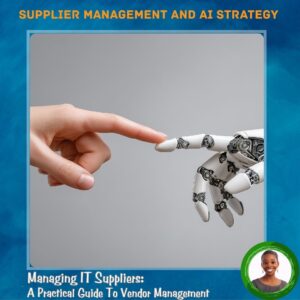
South Africa’s proposed AI Law was created to address some of these questions, yet even this document needed to be retracted after it was found to contain AI hallucinations (https://www.reuters.com/world/africa/south-africa-withdraws-ai-policy-due-fake-ai-generated-sources-2026-04-27/). This leaves us with a question of what to do when faced with incessant AI-led cyber attacks and increased demands to host data centers that will cater to the AI revolution. An effective AI strategy should therefore be a primary concern for both the public and private sector.
In the meantime, what can procurement do to help business leaders who are getting ready to ascend the AI mountain? First of all, make sure that your contracts abide by existing laws and regulations as well as being aligned to those existing in countries that your company does business with. Then keep your security protocols updated and plug all potential data leaks. This move is to counteract any outside threats that seek to steal your data and work methodology. Currently, South Africa faces an average of 2,145 cyber attacks per month. Most of these use AI to identify weaknesses in your current defenses. Don’t become a statistic like Standard Bank and Liberty Life (https://tanosec.co.za/2026/04/13/south-africa-data-breach-2026/), who were subjected to this type of data leak earlier this year (March 2026).
Managing IT Suppliers : A Practical Guide To Vendor Management (https://www.takealot.com/managing-it-suppliers/PLID99345895) lays out the steps that your security team can take alongside your suppliers to help them address the challenges of AI implementation. If you have exhausted all the steps laid out in Chapter 6 and would like further input on how to optimize your supplier management strategy for the AI revolution, feel free to reach out for a chat.




1 Comment
XSMB 30 NGAY · May 11, 2026 at 4:46 am
This is a thoroughly considered and well-articulated analysis that contributes meaningfully to industry dialogue.